# Setup Namespace

## Overview

Servoy Cloud uses a concept called a `namespace` to organize your applications, delivery pipelines, and environments. Each Namespace serves as a unique identifier for your company or organization within the cloud.

## Setup

To start using Servoy Cloud, you must first create your namespace. Without a namespace, you cannot create, manage, or deploy applications to the cloud.

***

Below are the steps to create your namespace:

### Step 1: Provide Basic Information

You will need to specify the following information:

1. **Namespace**: The name of your namespace.
2. **Application**: The name of your first application within the namespace.

{% hint style="warning" %}
A valid namespace or application name must meet the following criteria:

\- Composed of lowercase letters, numbers, or hyphens ("-").

\- Maximum length of 50 characters.

\- Starts and ends with alphanumeric characters.
{% endhint %}

These names are critical as they form part of the URL to access your cloud application.

For example, if you provide the following:

* **Namespace**: `servoy`
* **Application**: `crm-application`

Your application will be accessible at: `https://crm-application-dev.servoy.servoy-cloud.eu`

### Step 2: Verify details

This step is to verify the namespace details you've provided. Please note that once confirmed, you can't make any changes to your namespace setup.

### Step 3: Complete the setup

After confirming your namespace details, the namespace will be created in the cloud environment, allowing you to create, manage, and deploy applications in the cloud.

Your namespace is being set up behind the scenes. This process may take approximately 10 minutes. Please note that the duration may vary depending on various factors. Once the setup is complete, you will be able to access your namespace via the Servoy Cloud Control Center.\
\
Once the namespace setup is complete, the [Home](/reference/servoy-cloud/cloud-control-center/home.md) page will serve as a dashboard for the latest namespace activity.\\

### Step 4: Open application in Servoy Developer

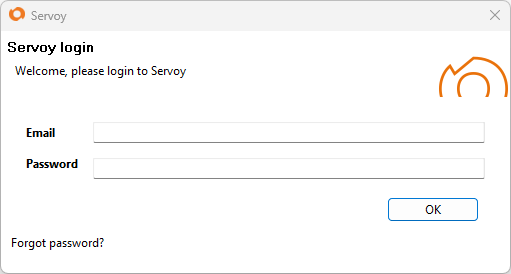
Once you have downloaded and opened Servoy Developer, use the Servoy Cloud Control Center credentials to log in.

<figure><img src="/files/tMnYAU3x60a2EIydTOLR" alt=""><figcaption><p>Servoy Developer login dialog using Servoy Cloud credentials</p></figcaption></figure>

{% hint style="info" %}
If the login dialog is closed without logging in, open it by clicking the Servoy icon <img src="/files/N1WJgtPivBWYMFykPJcZ" alt="" data-size="line"> in the bottom right corner of Servoy Developer.
{% endhint %}

After successful sign-in, a dialog box will appear prompting you to select your application.
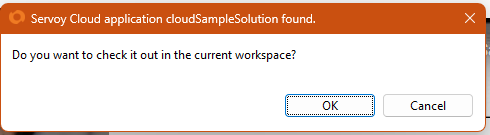
<figure><img src="/files/U48e1kZLhCFDG2QHgfRN" alt="" width="368"><figcaption><p>Check out application dialog box</p></figcaption></figure>

After making your selection, the source code will be automatically checked out into your local workspace.

{% hint style="info" %}
If the select application dialog does not show, switch into an empty workspace. This will ensure that you don't corrupt your application with files from an existing project.
{% endhint %}


---

# Agent Instructions: Querying This Documentation

If you need additional information that is not directly available in this page, you can query the documentation dynamically by asking a question.

Perform an HTTP GET request on the current page URL with the `ask` query parameter:

```
GET https://docs.servoy.com/reference/servoy-cloud/cloud-control-center/home/setup-namespace.md?ask=<question>
```

The question should be specific, self-contained, and written in natural language.
The response will contain a direct answer to the question and relevant excerpts and sources from the documentation.

Use this mechanism when the answer is not explicitly present in the current page, you need clarification or additional context, or you want to retrieve related documentation sections.
