> For the complete documentation index, see [llms.txt](https://docs.servoy.com/llms.txt). Markdown versions of documentation pages are available by appending `.md` to page URLs; this page is available as [Markdown](https://docs.servoy.com/reference/servoy-developer/object-editors/form-editor/form-editor-less-tab.md).
# Less
## Overview
Form Editor - Less Tab
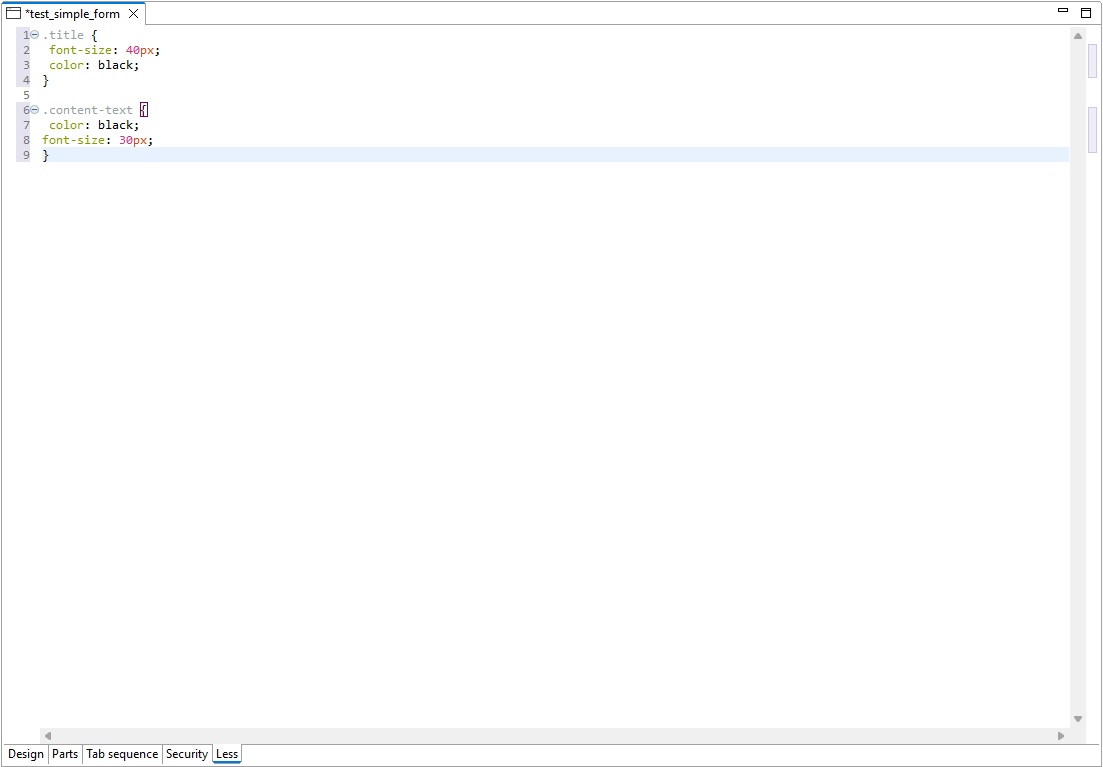
The **Less tab** of the Form Editor allows you to create and edit **form-scoped stylesheets**, written in LESS.\
This enables encapsulated styling that applies **only to the current form**, without affecting other forms or global styles.
When a form-specific LESS file exists, it opens directly in this tab for editing.
Form components do not have a Less tab. To style the elements inside a form component, give them a `styleClass` and define that class in your solution-level LESS.
### Overriding global styles & inheritance
Form-level LESS allows you to override global solution styles or build unique layouts scoped to a single form.\
It also plays nicely with **form inheritance**, letting child forms override base styles without affecting other forms.
For examples of how this works, including overrides, inheritance, and responsive layouts, see the [**Form-Level LESS Styling Guide**](/guides/develop/application-design/styling-and-themes/css-less.md#form-level-styling-scoped).
## Sections
### Create Form Less file
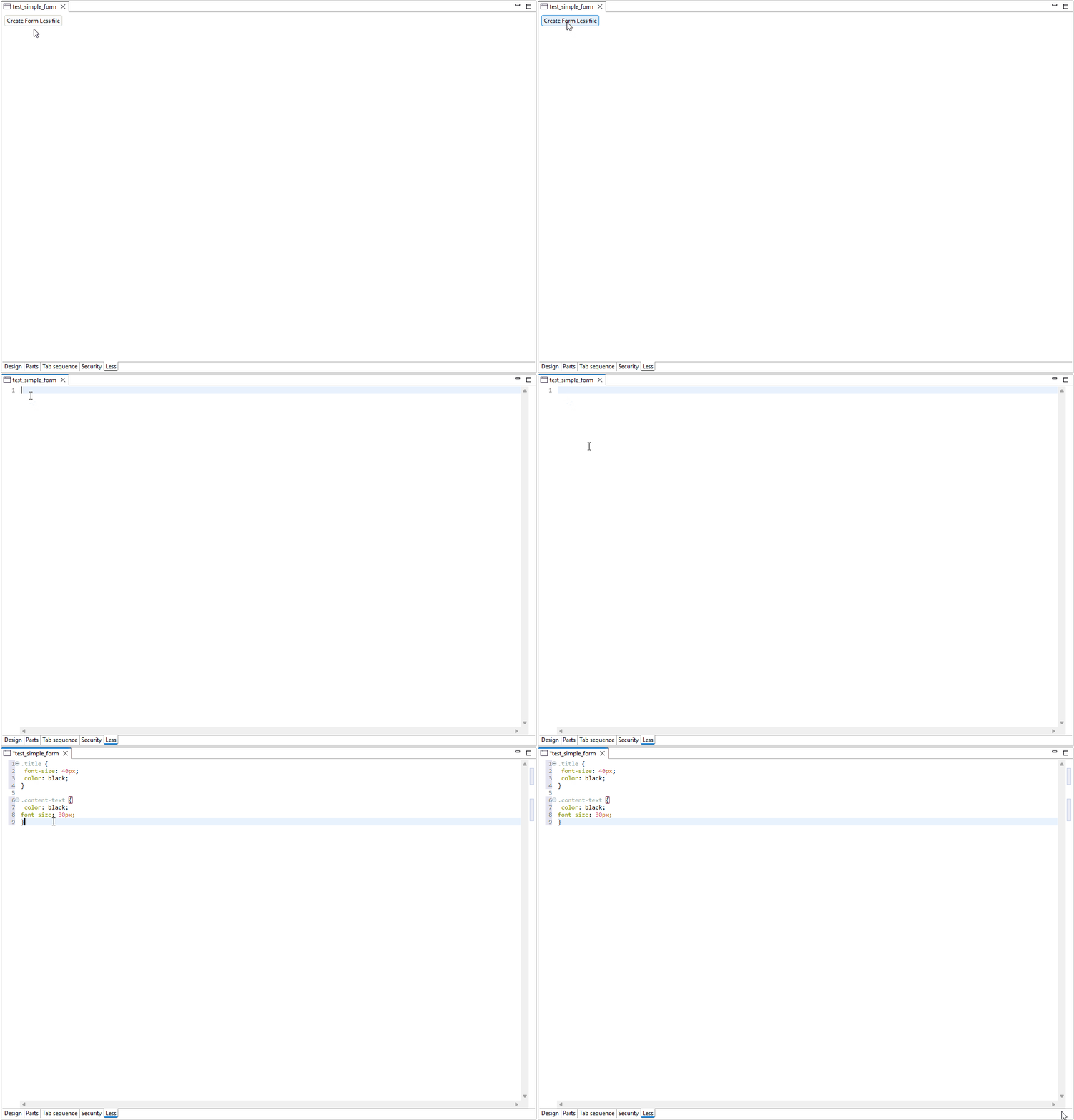
* A button at the top labeled `Create Form Less file`.
* Clicking it generates a `.less` file tied specifically to the current form.
### Editor Area
* Once created, the Less tab becomes an editor where you can write LESS (or plain CSS).
* This area supports full LESS syntax, such as variables, mixins, and nesting.
## Using the Less tab
Creating and editing form-specific LESS
Here are the steps for using the **Less tab**:
1. **Create the LESS file**
* Click the `Create Form Less file` button. This action generates a `.less` file tied directly to the form.
2. **Write styles**
* Enter your LESS or CSS rules in the editor.
* Use this space to define styles that apply only to this form.
3. **Save your work**
* Unlike automatic saving, you must explicitly save (for example with `Ctrl+S` or using the standard save command) to persist changes.
---
# Agent Instructions
This documentation is published with GitBook. GitBook is the documentation platform designed so that both humans and AI agents can read, navigate, and reason over technical content effectively. Learn more at gitbook.com.
## Querying This Documentation
If you need additional information that is not directly available in this page, you can query the documentation by asking a question.
Perform an HTTP GET request on the following URL with the `ask` and `goal` query parameters:
```
GET https://docs.servoy.com/reference/servoy-developer/object-editors/form-editor/form-editor-less-tab.md?ask=&goal=
```
`ask` is the immediate question: it should be specific, self-contained, and written in natural language.
`goal` is what the user is ultimately trying to achieve, the reason they need the answer. Sharing it helps GitBook give you a better, more relevant answer. A goal is most helpful when it describes the outcome the user wants rather than restating the question. For example, with `ask=how do I create an API token`, a goal like `automate deployments from our CI pipeline` lets GitBook tailor the answer to that use case.
The response will contain a direct answer to the question and relevant excerpts and sources from the documentation.
Use this mechanism when the answer is not explicitly present in the current page, you need clarification or additional context, or you want to retrieve related documentation sections.