> For the complete documentation index, see [llms.txt](https://docs.servoy.com/llms.txt). Markdown versions of documentation pages are available by appending `.md` to page URLs; this page is available as [Markdown](https://docs.servoy.com/reference/servoy-developer/object-editors/debug-configuration.md).
# Debug Configurations
A wizard for Debug Configurations
## Overview
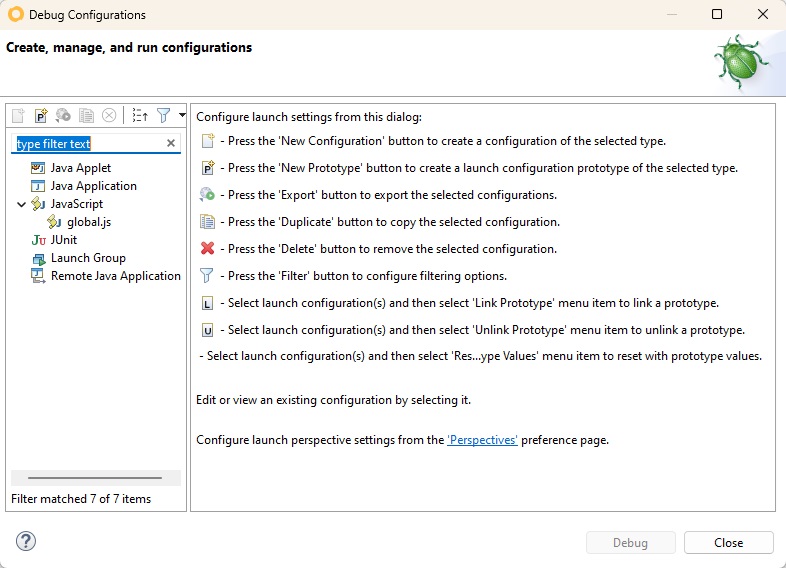
The **Debug Configurations Wizard** allows users to create, manage, and run different debugging configurations for their projects. This tool is essential for setting up various debugging environments and managing how applications are debugged.
Debug Configurations
## Sections
### Configuration Actions
A set of actions that can be performed on configurations, displayed as icons in a toolbar. These actions allow users to create new configurations, export, duplicate, delete, and filter configurations:
* New launch configuration: Creates a new configuration of the selected type.
* New launch configuration prototype: Creates a launch configuration prototype of the selected type.
* Export launch configuration: Exports the selected launch configurations.
* Duplicate: Duplicates the currently selected launch configuration.
* Delete: Removes the selected launch configuration(s).
* Collapse: Collapses all expanded launch configuration.
* Filter: Options to filter the list of configurations to make it easier to manage and find specific configurations:
* Filter Closed Projects: Excludes configurations from closed projects.
* Filter Deleted/Unavailable Projects: Excludes configurations from deleted or unavailable projects.
* Filter Configuration Types: Filters the list based on configuration types.
* Apply Window Working Set(s): Applies the current working set(s) to the filter.
* Filtering Preferences: Opens the Launch Configurations preferences dialog for more advanced options.
### Filter Field
Allows users to filter the list of configurations by typing in keywords or phrases.
### Configuration Types
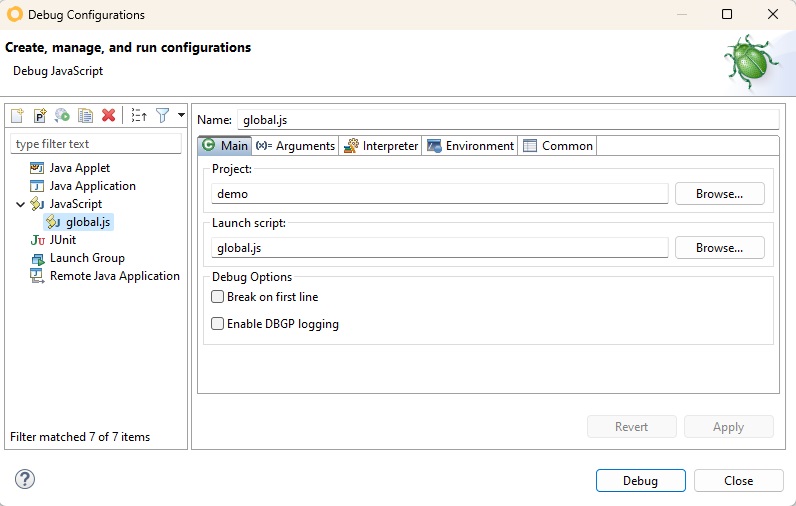
A list of available configuration types that users can create and manage. This includes configurations for Java Applets, Java Applications, JavaScript, JUnit tests, and Launch Groups.
Examples of Internal Editors:
* Java Applet
* Java Application
* JavaScript
* JUnit
* Launch Group
* Remote Java Application
### Configuration Instructions
Provides detailed instructions on how to configure and manage external tool configurations. This includes creating new configurations, duplicating, deleting, and exporting them.
### Buttons
Here are the available buttons:
#### Debug
Executes the selected configuration in debug mode.
#### Close
Closes the Debug Configurations dialog without making any changes.
## Using the Debug Configurations
Debug Configurations
You can find [here](https://help.eclipse.org/latest/index.jsp?topic=%2Forg.eclipse.cdt.doc.user%2Ftasks%2Fcdt_t_new_run_config.htm\&resultof%3D%2522%2572%2575%256e%2522%2520%2522%2563%256f%256e%2566%2569%2567%2575%2572%2561%2574%2569%256f%256e%2573%2522%2520%2522%2563%256f%256e%2566%2569%2567%2575%2572%2522%2520) information about using the **Debug Configurations**.
---
# Agent Instructions
This documentation is published with GitBook. GitBook is the documentation platform designed so that both humans and AI agents can read, navigate, and reason over technical content effectively. Learn more at gitbook.com.
## Querying This Documentation
If you need additional information that is not directly available in this page, you can query the documentation by asking a question.
Perform an HTTP GET request on the following URL with the `ask` and `goal` query parameters:
```
GET https://docs.servoy.com/reference/servoy-developer/object-editors/debug-configuration.md?ask=&goal=
```
`ask` is the immediate question: it should be specific, self-contained, and written in natural language.
`goal` is what the user is ultimately trying to achieve, the reason they need the answer. Sharing it helps GitBook give you a better, more relevant answer. A goal is most helpful when it describes the outcome the user wants rather than restating the question. For example, with `ask=how do I create an API token`, a goal like `automate deployments from our CI pipeline` lets GitBook tailor the answer to that use case.
The response will contain a direct answer to the question and relevant excerpts and sources from the documentation.
Use this mechanism when the answer is not explicitly present in the current page, you need clarification or additional context, or you want to retrieve related documentation sections.